
Swing Weight Calculator
Calculate your golf club’s swingweight in g·in and standard scale (A0-G9)
Club Specifications
Results
Finding a reliable swing weight calculator can feel like a wild goose chase. You just want a straightforward tool to understand the feel of your equipment, not a complicated physics lesson. We created this page and our free calculator to solve that exact problem, giving you the accurate numbers you need to fine-tune your game in golf or cricket.
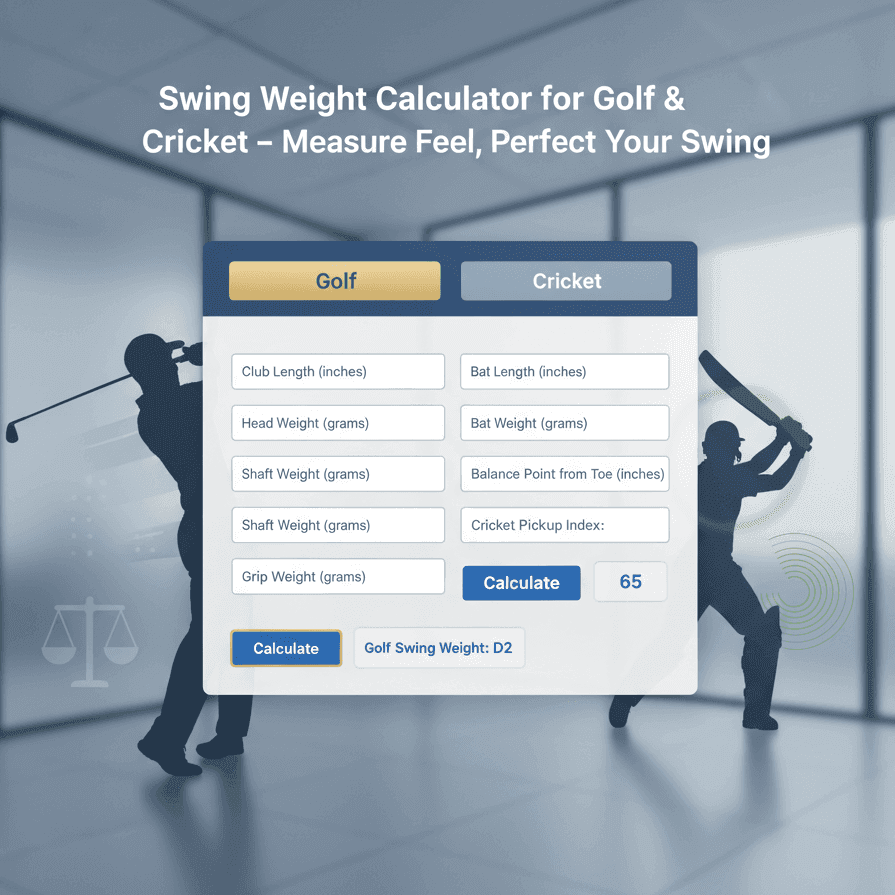
- Golf Tab Inputs: Club Length (inches), Head Weight (grams), Shaft Weight (grams), Grip Weight (grams).
- Cricket Tab Inputs: Bat Length (inches), Bat Weight (grams), Balance Point from Toe (inches). The tool should have a clear “Calculate” button and display the result prominently (e.g., Golf Swing Weight: D2, Cricket Pickup Index: 65).
Introduction to Swing Weight in Sports
What Is Swing Weight?
Swing weight is a measurement of how heavy a piece of sporting equipment, like a golf club or cricket bat, feels when you swing it. It is not the total weight you’d see on a scale. Instead, it’s about the distribution of that weight and its effect on the balance and feel during motion.
Imagine holding a sledgehammer. If you grip it right below the heavy metal head, it feels manageable. But if you hold it at the very end of the long wooden handle, it feels much heavier and harder to control. The sledgehammer’s actual weight hasn’t changed, but its swing weight has.
This concept is crucial in sports where a consistent swing is the key to success. It’s measured using specific scales to help athletes match the feel of their equipment. This ensures every swing feels familiar, which helps build repeatable and reliable technique.
Why Swing Weight Matters in Golf and Cricket
In both golf and cricket, your success depends on repeating a complex motion with precision. A consistent swing weight across all your clubs or for your chosen bat is vital. It allows your body to develop a single, fluid swing instead of having to adjust for different-feeling pieces of equipment.
If your 7-iron feels drastically different from your 8-iron, your timing and tempo will be thrown off. In cricket, if a new bat feels heavier in the pickup than your old one, it can slow down your bat speed and ruin your timing against a fast bowler. Matching swing weights eliminates these variables, letting you focus purely on your technique.
How Swing Weight Affects Power, Control, and Speed
The balance of your equipment directly impacts your performance. A heavier swing weight can generate more momentum and potentially more power, but it might come at the cost of speed. You might hit the golf ball further, but your swing might be slower and harder to control.
Conversely, a lighter swing weight can increase your swing speed and give you a greater sense of control. This is often preferred for players who rely on timing and precision. The perfect swing weight is a personal preference, representing the ideal trade-off between power and control that matches your specific strength and swing style.
Understanding the Concept of Swing Weight
The Science Behind Swing Weight
The science of swing weight revolves around a principle called the “moment of inertia.” This sounds complicated, but it’s just a measure of how much force is needed to get an object rotating around a pivot point. In this case, the object is your club or bat, and the pivot point is your hands.
A higher moment of inertia means an object is harder to start swinging and, just as importantly, harder to stop. In sports terms, it feels heavier to swing. This is why a club with a heavier head feels like it has a higher swing weight, even if its total weight is the same as a club with a lighter head. It requires more effort to swing.
Key Factors That Influence Swing Weight (Mass, Balance Point, and Moment of Inertia)
Three main elements determine the swing weight of your equipment. The first is the total mass or static weight of the club or bat. Obviously, a heavier object will generally have a higher swing weight.
The second, and more critical, factor is the balance point. This is the point where the equipment would balance perfectly if you placed it on your finger. The further this balance point is from your hands (the pivot point), the heavier the equipment will feel to swing. The third factor, the moment of inertia, is the result of the interplay between the first two.
Measuring Swing Weight Accurately
In golf, swing weight is measured on a formal alphanumeric scale using a special device. The scale runs from A0 (the lightest feel) to G9 (the heaviest). Each letter grade has ten points, from 0 to 9. For example, D1 is slightly lighter than D2, which is lighter than D3.
Most men’s clubs fall in the D0 to D5 range. For cricket, the concept is often referred to as “pickup,” which is a more subjective feel but is based on the same principles of mass and balance point. An accurate swingweight calculator uses the equipment’s physical measurements to assign it a value on this established scale.
Swing Weight Calculator for Golf
How Swing Weight Works in Golf Clubs
The swing weight of a golf club dictates its feel and rhythm during the swing. Every component—the club head, the shaft, and the grip—influences the final balance. A heavier club head, a longer shaft, or a lighter grip will all increase the swing weight, making the club feel more “head-heavy.”
This balance is what helps a golfer maintain a consistent tempo. A club with a swing weight that is too light may cause a golfer to swing too quickly and lose their rhythm. A club that is too heavy might slow the golfer down and cause them to lose distance. Our golf swing weight calculator helps you find this balance.
Steps to Use a Swing Weight Calculator for Golf
Using a golf club swing weight calculator is a simple process. First, you need to gather three key measurements from your club. You will need the total weight of the club head in grams.
Next, you need the weight of the shaft in grams. Finally, you will need the weight of the grip in grams. Input these three values into the designated fields in the calculator, along with the club’s total length in inches, and the tool will instantly provide you with the calculated swing weight.
Common Mistakes to Avoid When Calculating Golf Swing Weight
The most common mistake is using inaccurate measurements. Guessing the weight of your components will lead to a useless result. Use a digital kitchen scale to get precise gram measurements for the head, shaft, and grip.
Another error is measuring the club length incorrectly. Per industry standards, the length should be measured from the top of the grip down the shaft to the point where a straight line extending from the sole of the club intersects it. Confusing static weight with swing weight is also a frequent misunderstanding.
Adjusting Swing Weight for Better Performance on the Course
Small adjustments can make a big difference. To increase a club’s swing weight, you can add lead tape directly to the club head. As a rule of thumb, two grams of weight added to the head will increase the swing weight by approximately one point (e.g., from D1 to D2).
To decrease the swing weight, you can add weight to the handle end, a technique known as counter-balancing. Adding a heavier grip is a simple way to do this. Fine-tuning with a golf swing weight calculator can help you match every club in your bag for a perfectly consistent feel.
Swing Weight Calculator for Cricket
Importance of Swing Weight in Cricket Bat Mechanics
In cricket, the “pickup” of a bat is the equivalent of swing weight. It describes how the bat feels to lift and swing, which is often more important than its actual dead weight. Two bats can have the same static weight but vastly different pickups due to their balance points.
A bat with a light pickup feels easy to control and allows for quick wrist movements, which is ideal for touch players and reacting to fast bowling. A bat with a heavier pickup might feel more sluggish but can provide more power through the shot for players who rely on strength. The bat’s swing weight is fundamental to a batsman’s timing and power.
How to Use a Swing Weight Calculator for a Cricket Bat
Our swing weight calculator for cricket bats requires a few simple inputs. You’ll need the bat’s total weight in grams and its overall length. The most crucial measurement is the balance point, measured from the toe of the bat.
Once you enter these figures, the calculator provides a pickup index. This value gives you a consistent way to compare different bats. A lower index indicates a lighter pickup, while a higher number suggests a heavier-feeling bat, allowing you to find a new bat with the same feel as an old favorite.
Ideal Swing Weight for Fast Bowlers vs. Spin Bowlers
When facing a fast bowler, a batsman has very little time to react. A bat with a lighter pickup is generally preferred as it allows for faster hand speed and quicker adjustments to the line and length of the ball. It helps you get the bat into position in time to play a defensive shot or a quick counter-attack.
Against a spin bowler, timing is still important, but you often have more time to read the ball. Some players may prefer a bat with a slightly heavier swing weight to generate more power and clear the field. It allows them to “get through” the shot and hit the ball with more authority when attacking the spinner.
Tips to Optimize Swing Balance for Consistent Performance
Finding the right pickup is a process of trial and error. Don’t just look at the static weight on the sticker. Pick up different bats and feel their balance. A bat might seem heavy, but if it has a high balance point (closer to the handle), it might have a surprisingly light pickup.
Once you find a bat with a pickup you love, use a swing weight calculator to quantify it. Record the bat’s weight and balance point. This data becomes your personal specification, making it much easier to find a replacement bat with the exact same feel in the future.
Comparing Swing Weight in Golf and Cricket
Similarities in Swing Dynamics
At their core, both golf and cricket swings are about transferring energy from the body, through the equipment, and into a ball. Both sports rely on a kinetic chain, where energy is built up from the ground through the legs and core and finally released through the hands.
In both sports, the concept of a consistent “feel” is paramount. An athlete wants their equipment to feel like a natural extension of their body. A mismatched swing weight in either sport can disrupt this feeling, causing a breakdown in timing and mechanics that leads to poor results.
Key Differences Between Golf and Cricket Swing Mechanics
The primary difference is the swing plane. A golf swing is a more rotational movement on an inclined plane. A cricket swing, especially a straight drive, is a more vertical motion, like a pendulum.
Golf is a one-lever system focused on maximizing clubhead speed at a single impact point. Cricket involves more complex, two-lever actions using the wrists, and the goal is to hit the ball to different parts of the field, not just as far as possible. These different mechanics mean that the ideal swing weight for each sport serves a different purpose.
How Equipment Design Affects Swing Weight
Golf club design has evolved to manipulate swing weight with precision. Modern drivers have movable weights in the head, and shafts come in countless weight and flex profiles. All these components are designed to alter the club’s balance point and moment of inertia.
Cricket bat design achieves this through shaping. Bat makers can create a lighter pickup by removing wood from certain areas (like “scalloping” the back of the bat) or by using a higher middle. The shape of the bat, its spine profile, and edge thickness all contribute to its balance and feel, directly impacting its swing weight.
How Swing Weight Calculators Work
The Formula Behind Swing Weight Calculation
A swing weight calculator uses a formula based on the principles of a balance scale. The formula takes the mass of the equipment and its balance point relative to a fixed pivot point (usually 14 inches from the grip end for golf clubs). It calculates the “torque” or rotational force the equipment creates around that point.
This calculated torque is then converted into the familiar alphanumeric scale found on a swing weight chart. While the exact formula is complex, it’s essentially a mathematical way of replicating what a physical swing weight scale does. It quantifies the “feel” of the club or bat into a consistent, objective number.
Input Parameters: Length, Mass, and Balance Point
To get an accurate result, the calculator needs precise inputs. Total mass (or the weight of individual components) provides the foundation for the calculation. A heavier object will naturally create more torque.
The length and balance point are crucial for determining how that mass is distributed. A longer club or a bat with a balance point further from the hands will have a greater lever effect. This increases the moment of inertia and results in a higher swing weight, even if the total mass remains the same.
Example Calculation for a Golf Club and Cricket Bat
Let’s consider a standard golf driver. It might have a 200-gram head, a 60-gram shaft, and a 50-gram grip, with a total length of 45 inches. A golf swing weight calculator would process these inputs and might return a result of D2, a very common value for a men’s driver.
For a cricket bat, imagine one that weighs 1150 grams and has a balance point 35cm from the toe. A calculator would use these figures to produce a pickup index. This allows a player to compare it to another bat that also weighs 1150 grams but has a balance point at 38cm, which would feel noticeably heavier.
Understanding Output Results and What They Mean
The output from a swingweight calculator gives you an objective language to describe feel. For golfers, knowing your ideal driver is a D3 helps you test new clubs with confidence. If a new club is a C9 (much lighter) or a D7 (much heavier), you know it will likely disrupt your timing.
For cricketers, knowing your preferred pickup index helps you buy bats online or order a custom bat with more certainty. You can tell a bat maker you want a 2lb 9oz bat with a specific pickup feel. This removes the guesswork and ensures you get equipment that matches your personal playing style.
Benefits of Using a Swing Weight Calculator
Improve Accuracy and Consistency
The single biggest benefit of matching your equipment’s swing weight is improved consistency. When every club in your bag or every bat you use has the same feel, your body doesn’t have to make tiny adjustments from one shot to the next. You can groove one swing.
This leads directly to better accuracy. Your muscle memory takes over, and you can repeat your best swing more often. Whether it’s hitting more fairways in golf or finding the gaps in the field in cricket, a consistent swing weight is the foundation for reliable performance.
Customize Equipment for Your Personal Playing Style
A swing weight calculator empowers you to become your own equipment expert. You can experiment with different setups to find what works best for you. You are no longer reliant on off-the-shelf standard specifications.
Do you have a fast, aggressive swing? You might benefit from a slightly heavier swing weight for more stability. If you have a smoother tempo, a lighter swing weight might help you maximize speed. The calculator is the tool that lets you quantify these adjustments and build a set of equipment that is perfectly tailored to your unique swing.
Reduce Fatigue and Enhance Control
Using equipment that is improperly balanced for your strength can cause fatigue over a round of golf or a long cricket innings. A club or bat that is too heavy forces your smaller muscles to work overtime, leading to a loss of control and an increased risk of injury.
By optimizing your swing weight, you ensure that you’re swinging with maximum efficiency. The equipment feels balanced and easy to manage, which gives you a greater sense of control over the clubface or bat face at impact. This translates to better shot-making from the first tee to the 18th green.
Better Shot Precision for Professional and Amateur Players
Professional athletes obsess over the details of their equipment, and swing weight is at the top of the list. They know that even a tiny change can be the difference between a good shot and a great one. This same principle applies to amateur players.
Using a tool like a swing weight calculator brings a professional level of detail to your game. It helps you understand your equipment on a deeper level. This knowledge allows you to make informed decisions that lead directly to better precision and, ultimately, lower scores or more runs.
Manual vs. Online Swing Weight Calculators
Advantages of Using an Online Tool
The biggest advantage of an online swing weight calculator is accessibility. Anyone can use it anytime, without needing to purchase specialized equipment. It’s fast, free, and provides instant results that are accurate enough for the vast majority of players.
Online tools also allow for quick experimentation. You can easily change one variable, like grip weight, to see how it affects the overall swing weight. This is impossible to do quickly with a physical scale, making an online calculator an excellent resource for planning equipment modifications.
Manual Calculation Methods Explained
The traditional method for measuring swing weight involves a physical device called a swing weight scale. It’s essentially a balance beam with a fulcrum and a sliding weight. You place the club on the beam, and the point at which it balances corresponds to a reading on the alphanumeric swing weight chart.
This method is the gold standard for precision and is what club builders and manufacturers use. However, these scales can be expensive and aren’t practical for the average player to own. They offer a high degree of accuracy but low convenience.
Which Method Is Best for You?
For 99% of golfers and cricketers, an online swing weight calculator is the perfect tool. It provides all the necessary information to make intelligent decisions about your equipment. It helps you understand the feel of your current clubs and plan for future purchases or adjustments.
If you are a professional club fitter or a serious hobbyist who builds your own clubs, then a manual scale is a worthwhile investment. For everyone else, our online tool offers the ideal combination of accuracy and convenience. It gives you actionable data without the cost or complexity of a physical scale.
Tips to Improve Your Swing Weight Efficiency
How to Find Your Ideal Swing Weight
There is no single “ideal” swing weight; it is entirely dependent on your personal strength, tempo, and feel. The best way to find yours is through experimentation. Start by hitting balls with clubs of different swing weights and pay close attention to which one allows you to make your most consistent, effortless swing.
Use a swing weight calculator to find the value of a club you hit particularly well. That value (for example, D2) becomes your baseline. From there, you can test clubs that are slightly lighter (D1) or heavier (D3) to see if you can improve your performance even further. Your goal is to find the weight that gives you the best blend of speed, control, and solid contact.
Common Mistakes Players Make
One of the biggest mistakes is assuming a heavier swing weight automatically means more distance. For many players, a club that is too heavy will slow down their swing speed, actually costing them distance. Another common error is ignoring the other clubs in the set; your driver, irons, and wedges should ideally have a progressively matched swing weight.
Chasing the specifications of a professional player is another trap. Just because your favorite golfer uses a club with an E2 swing weight doesn’t mean it will work for you. Their specs are tailored to their world-class strength and technique. It’s crucial to find what works for your swing, not someone else’s.
Adjusting Equipment to Match Your Swing Style
Making adjustments is simple once you know your numbers. If you find your swing is too quick or erratic, increasing the swing weight by adding lead tape to the club head can help smooth out your tempo. This gives you a better sense of where the club head is during the swing.
If you feel like you’re struggling to generate club speed or the club feels cumbersome, you might need to lower the swing weight. You can achieve this by installing a heavier grip or asking a club builder to add a small weight inside the shaft under the grip. This counter-balancing technique can make the club head feel lighter and easier to swing.
Expert Insights and Practical Recommendations
What Professionals Say About Swing Weight
Professional golfers and club fitters treat swing weight as one of the most critical specifications. Master club builder Bob Vokey has noted that matching the swing weights of a player’s wedges to their irons is key for consistent feel and distance control in the short game.
Top players can often detect a change of a single swing weight point. They know that this small change in balance can affect the timing of their release and the quality of their ball striking. For them, swing weight isn’t a minor detail; it’s a fundamental part of what makes their equipment perform reliably under pressure.
How Manufacturers Optimize Swing Weight in Modern Equipment
Equipment manufacturers invest millions in research and development to optimize swing weight. They design clubs and bats for different types of players. A “game improvement” iron, for instance, might have a different swing weight profile than a “players” blade, designed for a more skilled golfer.
Modern drivers often feature adjustable weight ports. These allow a golfer to change the swing weight and also influence the shot shape (draw or fade bias). This is a direct acknowledgment from manufacturers that a one-size-fits-all approach to swing weight is obsolete. Customization is key to performance.
Frequently Asked Questions (FAQs)
What Is the Ideal Swing Weight for a Golf Club?
There is no universal ideal swing weight for a golf club. The right value is highly personal and depends on a player’s strength, swing tempo, and preference. However, a common range for men’s standard-length irons is D0 to D5, while women’s clubs are typically in the C4 to C9 range.
The goal is not to find one “perfect” number but to find the number that works for you. A good starting point is to use a swing weight calculator on the favorite iron in your bag. That value can serve as the target for the rest of your set to ensure a consistent feel.
Can Swing Weight Affect Speed and Spin in Cricket?
Yes, absolutely. A bat with a lighter pickup (lower swing weight) can be swung faster, which can translate to higher ball speed off the bat. However, a bat with a heavier swing weight, if the player is strong enough to manage it, can offer more mass at impact, potentially generating more power and backspin.
The balance also affects how a player can manipulate the bat face. A lighter-feeling bat might allow for more subtle wrist movements, helping a player impart sidespin to guide the ball through gaps in the field. There is a direct relationship between the bat’s balance and the types of shots a player can execute effectively.
Do Swing Weight Calculators Work for All Types of Clubs and Bats?
Yes, the principles of mass and balance are universal, so a swingweight calculator works for any type of golf club or cricket bat. Whether you’re measuring a driver, a wedge, a youth cricket bat, or a professional’s bat, the physics remain the same.
The key is to have accurate input data. As long as you can provide the correct component weights and measurements, the calculator can provide a reliable and consistent swing weight value. This allows you to compare any two pieces of equipment on a level playing field.
How Often Should I Recheck My Swing Weight?
It’s a good idea to check your swing weights whenever you make a change to your equipment. The most common change is regripping your clubs. A new grip might have a different weight than your old one, which will alter the swing weight of the club.
You should also recheck if you have work done on a club, such as adjusting its length or reshafting it. It’s also wise to check your specs once a year, as your swing and strength can change over time. What worked for you last season might not be optimal for you today.
Final Thoughts
Key Takeaways on Swing Weight Calculations
Understanding swing weight is about moving beyond static weight and focusing on the feel and balance of your equipment. It’s the secret ingredient that links your entire set of clubs or helps you find the perfect cricket bat. A swing weight calculator is the most accessible tool to help you quantify this crucial variable.
It gives you the power to analyze, adjust, and customize your gear with confidence. By using objective data, you replace guesswork with precision. This leads to better equipment choices and a more consistent performance when it matters most.
Why Regular Measurement Matters for Long-Term Performance
Your game is not static, and neither is your equipment. Grips wear out, shafts can get bent, and your swing itself evolves. Regularly measuring your swing weight ensures that your equipment continues to match your needs.
It’s a simple check-up that can prevent bad habits from forming due to poorly balanced gear. Taking a few moments to use a swing weight calculator is an investment in your long-term consistency and enjoyment of the game. It’s a small step that can make a massive difference.